
Explore FAMES Activities!
Family Adventures with Exploring Science
Science is a way of understanding the world that begins in the very earliest years. Consequently, parental involvement is so important in a child’s science education. Parents can encourage early scientific thinking by questioning, discussing, and exploring together.
Observing: Encourage young children to notice small details.
What shapes do you see in the spider web?
Does this wool blanket feel different than
this cotton one?
Classifying: Put things in groups based on their characteristics.
Let’s sort the socks by color.
How are these bugs alike? How are they different?
Predicting: Make a guess what will happen and then try it.
How long will it take an ice cube to melt
in the kitchen?
How long will it take an ice cube to melt
outside?
Quantifying: Encourage children to describe the world around them.
Who is the tallest person in the family?
By how much?
How many steps does it take to walk across
your room? The kitchen?
Explore your home, your neighborhood, the grocery store, the park, etc. Science is everywhere!

Family Adventures with Bugs
- Did you know that the words “insects” and “bugs”
mean different things in science?
Insects have three parts (head, thorax, and abdomen), six legs, and usually wings. So, a spider is a “bug” but not an “insect.” Learn more about the different classes of “bugs” (arthropods)—insects, arachnids, crustaceans, and myriapods. - Read some children’s books about bugs that might interest your child.
- Go on a nature walk with an adult. Pretend to be an entomologist (a scientist who studies insects).
- How many types of bugs can your child identify? Discuss where the bugs might live (different habitats). What do they eat?
- Have your child draw a picture of a bug in its habitat, or have him or her write a story about a bug.
- Look at a dead or plastic bug under a magnifying glass.
- If you are interested in safely observing live bugs, check out a book such as Pet Bugs: A Guide to Catching and Keeping Touchable Insect by Sally Kneidel from your local library.
- Directions on how to make a net for capturing flying insects for observation:
- Take 1/2 yard of soft, nylon net and cut it in half so that you have a piece of net 18 inches by 30-36 inches. (Netting can be purchased at most fabric stores.)
- Sew the two 18-inch sides together to form a tube. (You may want
to use a product such as Jiffy Sew that “glues” fabric
together rather than using a needle and thread.)
- Take a wire coat hanger and straighten the hook part without untwisting it.
- Form a circle with the triangular part of the coat hanger.
- Sew one end of the tube of netting over the circle hanger. Gather the other end of the tube and tie it tight so the insects can’t escape.
- Attach the hanger to a dowel rod by taping the straightened hook to the end of a dowel rod with duct tape taping.
- Enjoy your net, but be careful of bees and other flying insects that might sting!
Family Adventures with Shapes (Spatial Sense)
- Read some children’s books about shapes (see bibliography for suggestions).
- Have your child cut out a shape (circle, rectangle, triangle, suare, etc.). Look around the house for things that look like that shape. Different types of food often are good examples of shapes.
- Have your child cut out many different shapes and make a picture with the shapes.
- Did you know that circles, rectangles, suares, triangles, etc. are
considered two-dimensional shapes—shapes that are flat?
Three-dimensional shapes are solid shapes that are not flat such as balls (spheres), blocks (cubes or rectangular prisms), cylinders, cones, etc. - Have your child build with blocks or make shapes with modeling clay.
- For other ideas, check out Shapes, Sizes & More Surprises by Mary Tomczyk at your local library.
- Read about tangrams, check out Grandfather Tang’s Story
by Ann Tompert—or go to Interactive
Tangram.
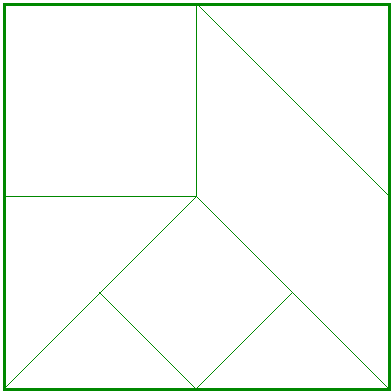
Print out the tangram template below, cut out the pieces, and try to rearrange them back into a square.
Family Adventures with Space
- Read some books about space, space travel, stars, or the solar system.
- With balloons of a variety of shapes and sizes, you and your child can enjoy “launching rockets.” Blow up a couple of balloons—do not tie off the end. Hold the end of the balloon closed until you are ready to let go and “launch” the balloon. What happened? Which one went farthest? What will happen next time? Does the shape of the balloon make a difference in the way that it flies? Does the amount of air you put in the balloon make a difference in the way it flies? Variation: Take a paper lunch bag and decorate it to be your “rocket.” Blow up a balloon (the long one works best) and place the decorated bag over the balloon. Let go of the balloon and see your rocket fly across the room.
- Collect lots of clothing (shirts, pants, coats, socks, etc.). To pretend to be an astronaut, you and your child can put on several layers of clothes, maybe even a backpack, and try to walk around the house. How do you feel? What movements were difficult to do?
- Pretend to be an astronaut working in space. Find a pair of gloves (winter mittens or rubber gloves) and some small objects (dice, pencils or pens, paper clips, screws and bolts, etc.). Put the gloves on and try to pick up the objects. This is fun to do with a friend!
- Pretend to land a spaceship on a planet with this bean bag activity. Before you begin, determine where the “landing site” will be. You can mark it off with a paper plate, shoe box, blocks, etc. Stand away from the site and try to toss your beanbag “rocket” so it lands on the landing site. Stand further away to make it more difficult. Notice the path of the beanbag as you throw it. It is more of a line or a curve?
- Have your child choose a planet to explore They can write a postcard to a friend or relative pretending to travel to this planet.
- Go out on a clear night (preferably someplace dark with few lights from houses or streets) and observe the night sky. If you have binoculars, take them with you. Discuss what you and your child see.
- To create night sky picture, draw a picture with wax crayons (not washable) and then paint over it with black watercolors. (The wax crayon should repel the watercolor allowing the crayon pictures to “shine” through.) Alternate suggestion: Draw a picture with markers and then color over the entire picture with a black crayon. Scratch off some of the crayon to see the “stars” in your night sky picture.
Star Facts
- Our sun is actually a star—it is the only star close enough to Earth for us to feel its heat.
- The sun is 93 million miles away from the Earth.
- The sun is so big that if it were hollow it could hold one million Earths.
- Without the sun’s light and heat, plants and animals could not survive.
- The temperature in the middle of the sun is about 27,000,000 degrees Fahrenheit.
- Stars are made of gases.
- Stars make heat and light from gases.
- Huge groups of stars in space are called galaxies.
- We live in the Milky Way Galaxy – it is made up of about one trillion stars.
- Stars are actually round—they look star-shaped from Earth because the light from the stars twinkle and blink.
- Patterns of stars in the sky are called constellations.
- On a clear, dark night you may be able to see several thousand stars.
|
Twinkle, Twinkle, |
—Pantomime— |
|
Twinkle, twinkle little star, |
—open and close hands— |
|
How I wonder what you are, |
—point to hand in wonder— |
|
Up above the world so high, |
—point to sky— |
|
Like a diamond in the sky, |
—make diamond shape with fingers— |
|
Twinkle, twinkle little star |
—open and close hands— |
|
How I wonder what you are! |
—point to head in wonder— |
|
—Anonymous |